
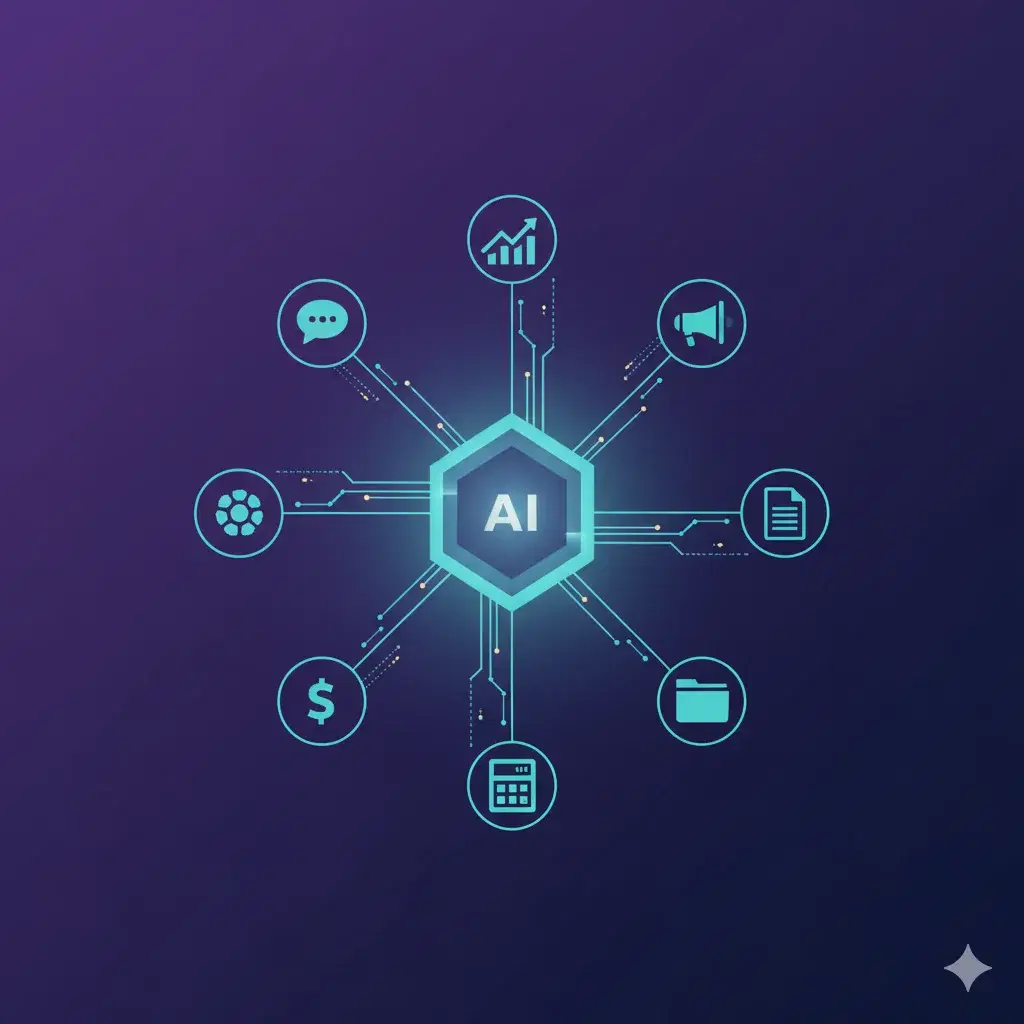
Business automation in 2026 is undergoing a major transformation. What started as simple rule-based workflows has evolved into intelligent, autonomous systems capable of understanding objectives and executing complex tasks across multiple platforms. AI agents are now becoming a central part of modern business infrastructure.
For years, companies relied on automation tools such as Zapier and UiPath to reduce repetitive manual work. These systems improved efficiency by following predefined rules: when X happens, perform Y. While effective for structured processes, they lacked flexibility. Any change in conditions often required manual updates.
AI agents represent the next stage of automation.
Built on advanced reasoning models developed by organizations like OpenAI and Anthropic, AI agents can interpret goals expressed in natural language, analyze context, create multi-step plans, connect to internal systems, and adapt in real time. Instead of executing static instructions, they work toward defined outcomes.
This shift is structural, not incremental.
From Task Automation to Outcome Automation
Traditional automation focuses on isolated tasks:
- Send an email after a form submission
- Move data between systems
- Generate scheduled reports
- Trigger notifications based on fixed rules
These actions improve efficiency but operate within narrow limits.
AI agents, however, focus on broader objectives:
- Increase customer retention
- Improve operational efficiency
- Reduce response times
- Optimize revenue performance
- Identify financial risks
The organization defines the goal. The AI agent determines how to achieve it, adjusting as data and conditions change.
How AI Agents Operate
AI agents differ from traditional software in several important ways:
Goal Interpretation They understand high-level instructions written in natural language and translate them into structured execution plans.
Multi-Step Reasoning They can coordinate sequences of actions across multiple systems instead of completing one task at a time.
System Integration They connect to APIs, databases, CRMs, financial platforms, and communication tools.
Context Awareness They evaluate available data before making decisions.
Adaptive Execution They refine actions based on feedback and performance results.
This makes them suitable for dynamic business environments where flexibility is essential.
Real-World Applications in 2026
AI agents are being integrated across key business functions.
Customer Support
AI agents manage full support workflows:
- Analyze incoming requests
- Retrieve customer history
- Process refunds or updates
- Draft policy-aligned responses
- Escalate complex cases when needed
This reduces response times, improves consistency, and lowers operational costs.
Sales and Revenue Operations
In sales teams, AI agents can:
- Qualify inbound leads
- Score prospects based on engagement data
- Update CRM systems
- Personalize outreach messages
- Schedule meetings automatically
- Forecast pipeline performance
This allows sales professionals to focus on closing deals rather than administrative work.
Marketing Optimization
Marketing teams use AI agents to:
- Analyze campaign performance
- Adjust advertising budgets
- Generate content variations
- Run continuous A/B testing
- Identify high-performing audience segments
Optimization becomes ongoing rather than periodic.
Finance and Risk Management
In finance, AI agents:
- Reconcile transactions
- Detect anomalies
- Generate executive summaries
- Forecast cash flow trends
- Monitor compliance signals
This shifts financial operations from reactive reporting to proactive decision-making.
Internal Knowledge Management
Organizations often struggle with scattered information across documents, emails, and communication tools.
AI agents help by:
- Aggregating data from multiple systems
- Answering complex internal questions
- Generating documentation
- Identifying inefficiencies
- Supporting onboarding processes
They act as an intelligence layer across the organization.
Strategic Advantages
The adoption of AI agents provides significant benefits:
- Lower operational costs
- Faster execution cycles
- Increased productivity
- 24/7 system availability
- Improved accuracy
- Scalable growth without proportional hiring
They also reduce the gap between insight and action, enabling faster decision-making across teams.
Implementation Considerations
AI agents are powerful, but successful deployment requires preparation.
Organizations need:
- Clean and structured data
- Secure API integrations
- Clear goals and measurable KPIs
- Governance and compliance frameworks
- Human oversight for sensitive decisions
AI agents enhance well-structured systems. Without proper infrastructure, results may be limited.
Final Perspective
In 2026, AI agents are becoming an essential component of modern enterprise operations. They enable businesses to move from static workflows to adaptive, goal-driven automation.
Companies that integrate AI agents strategically — rather than experimentally — are building faster, leaner, and more resilient organizations.
Automation is no longer just about triggers and scripts.
It is about intelligent systems that understand objectives and execute them efficiently at scale.
Ready to explore AI-powered automation for your business? Contact VLO Labs to discuss how intelligent agents can transform your operations.